Napoleone Martinuzzi and The Pulegoso Glass
23 November 2023
In a new catalog, bound in black and gold, images of a hundred objects stand out. It is the catalog of “100 Masterpieces in Ceramics and Glass of the Italian 20th Century” , Cambi Casa d’Aste’s live auction featuring an in-depth selection of only one hundred pieces: all masterpieces or rarities in ceramics and Murano glass made in the 20th century by great creators and the greatest Italian manufacturers.
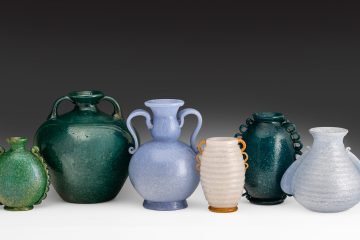
Top lot of the auction is a piece from the 1930s, the iconic Dieci Anse vase in emerald green pulegoso glass designed by Napoleone Martinuzzi for Venini, the twin of the one given to Gabriele D’Annunzio and still preserved at the Vittoriale.

Lot no. 63. Napoleone Martinuzzi, Venini, ca 1935 Submerged pulegoso glass vase with ten applied corded handles. Acid etched signature height 25.5 cm 28×22 cm.
Born in Murano on May 31, 1892, Napoleone Martinuzzi was an Italian sculptor, artist, and glass entrepreneur. Father of one of the most revolutionary materials in twentieth-century glass, the “pulegoso” and descendant of a family of Murano masters, son of Giovanni and Amalia Fuga, both members of families of master glassmakers, he studied music, sculpture, ceramics and goldsmithing at the Academy of Fine Arts in Venice and Rome. From 1908 he participated in the exhibitions of the Secessionist season at Ca’ Pesaro until 1920.
From the early 1920s Martinuzzi’s sculptural activity intersected with the practice of glassmaking. The association with Paolo Venini came in the following years, and in 1925 Vetri Soffiati Muranesi Venini & C. was born, of which Martinuzzi became a partner and artistic director. A unique style, derived from his experience as a sculptor, characterized him.
This dual production was also looked to by Gabriele D’Annunzio, who starting in 1921 commissioned Napoleone Martinuzzi, whom he had probably already met in Venice in 1917, to create sculptural works for the gardens and rooms of the Vittoriale degli Italiani. D’Annunzio also commissioned him to make numerous glass objects and engaged in correspondence with the glassmaker, in which he showed that he held his technical mastery in the highest regard.
The invention of “pulegoso glass” dates back to 1928, exploiting and emphasizing a manufacturing defect, namely a dense presence of bubbles produced by chemical agents during fusion, such that it became almost opaque. With this dark green-hued material Martinuzzi made an amphora exhibited at the 1928 Biennale, a large vase and a bowl for the Vittoriale by 1930.


He held the position of artistic director of Vetri Soffiati Muranesi Venini & C. until 1932. After the liquidation of Vetri Soffiati Muranesi Venini, Martinuzzi founded a new company with Francesco Zecchin, collaborating with two master glassmakers of the highest caliber, Otello Nason and Alfredo Barbini. The furnace’s achievements are distinguished by patterns and the use of materials far removed from the classical tradition. Martinuzzi won considerable acclaim from the public and critics, attending the Venice Biennale for thirteen editions (1920-1950), the Monza Triennale (1930) and the Milan Triennale (1933). He contributed with his creations to the establishment of a taste poised between art deco and “Novecento style.”
In 1936 Martinuzzi left the company to devote himself with greater commitment to sculpture. After a long interruption, in 1947 he moved to the artistic direction of Alberto Seguso’s Arte del vetro glassworks. From 1953 he collaborated with Gino Cenedese, until 1958, creating chandeliers and glass tiles; then in the 1960s he again designed works executed by A. Barbini for the Pauly firm. Martinuzzi died in Venice on May 15, 1977.

At Cambi Auction: Important Murano Glass
30 March 2026


Interview with Paolo Crippa – Director of the Numismatics Department
13 December 2025

Old Masters: Susanna and the Elders
9 December 2025
