Spinello Di Luca Spinelli known as Spinello Aretino
31 May 2024
The date of the auction dedicated to Old Masters organized by Cambi Auction House is approaching. The new catalog offers a careful selection of paintings, the result of careful research work carried out by our experts and esteemed art historians. Among the most important works is a magnificent tempera on panel with a gold background depicting St. John the Evangelist.

Known as Spinello Aretino, in honor of his hometown, Spinello di Luca Spinelli was a key transitional figure for the late Gothic style in late 14th and early 15th century Tuscany. Active for some forty years between Arezzo, Florence, Lucca and Pisa, this artist was the subject of particular attention by the great scholars of the 1960s, such as Miklós Boskovits and Stefan Weppelmann, whose interventions helped to expand a catalog that remains among the densest of the fourteenth century.
The work presented here can be traced back to the years of Spinello’s first Florentine sojourn, during which, in addition to creating the frescoes with the stories from the life of St. Benedict in the sacristy of San Miniato al Monte (datable to 1388), he also devoted himself to a rich production of works on panel, within which the artist drew inspiration from the refined sweetness of Bernardo Daddi’s models.

This beautiful panel, depicting St. John the Evangelist in a gentle and almost somewhat melancholy attitude, juxtaposed with the refined color choice of iridescent pinks and greens for the saint’s robes, well exemplifies the new elegance embraced by Spinello in the late 1380s.
First appearing on the market in 1987 within a Sotheby’s catalog, this panel was in all likelihood to be part of a more articulated iconographic complex, a polyptych with a gold background lost to date but which Massimo Ferretti has attempted to reconstruct within the study entrusted to him by antiquarian Giancarlo Gallino of Turin. The scholar hypothesized that the St. John could be juxtaposed with two additional compartments depicting a St. Augustine and a St. Dominic, which probably came from the same complex and appeared in a sale by Semenzato in Milan in November 1989 (lot No. 10).

These three figures of saints were probably intended to be placed, together with a fourth still unknown to this day, at the sides of a central panel depicting an enthroned Madonna and Child, perhaps also accompanied by a predella with Marian scenes or stories related to the lives of the saints depicted.
Should Massimo Ferretti’s hypothesis of reconstruction be confirmed, the presence of St. Dominic could perhaps provide some indication as to the commission and the place for which Spinello made the polyptych from which our panel comes, which was probably to be a convent belonging to the Dominican order.
Bibliography:
M. Ferretti, ed. G. Romano, Antichi Maestri Pittori. Fifteen years of study and research, exhibition catalogue, Turin, 1993, pp. 54-67;
E.S. Skaug, Punch Marks from Giotto to Fra Angelico, Oslo, 1994, p. 279;
A. Labriola, ‘La Decorazione Pittorica,’ in M. De Vita (ed.), L’Oratorio di Santa Caterina. Historical-critical observations on the occasion of the Restoration, Florence, 1998, pp. 51-59;
S. Weppelmann, Spinello Aretino and Fourteenth-Century Painting in Tuscany, Florence, 2011, pp. 178-180

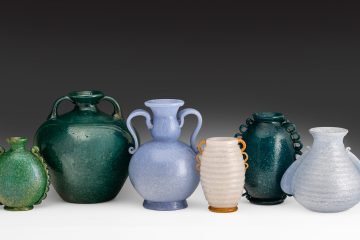
At Cambi Auction: Important Murano Glass
30 March 2026


Interview with Paolo Crippa – Director of the Numismatics Department
13 December 2025

Old Masters: Susanna and the Elders
9 December 2025
